Easter Games
Zoonomaly Unblocked
Zoonomaly Cat

Choo‑Choo Charles

Palworld
Weekly Picks
Zoonomaly Unblocked
Zoonomaly Cat
Choo‑Choo Charles
Palworld



You crouch beside a stack of crates with thirty seconds left on the hiding clock, brush in hand, and the wrong shade of grey is drying on your shoulder. Somewhere down the corridor a Seeker’s footsteps are getting closer, and you haven’t even started on your legs yet. This is the moment Meccha Chameleon is built around — not the chase itself, but the seconds before it, when a plain white body has to become part of the furniture.
| Genre | Hide-and-seek party game |
| Platform | Windows PC |
| Players per lobby | 2–10 recommended |
| Released | 2026 |
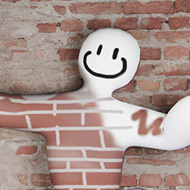
Every round splits the lobby into Hiders and Seekers, and every Hider starts identical: a blank, featureless white figure standing in the open. The entire game turns on what happens in the next stretch of seconds, when Hiders scatter across the stage and start sampling colors from nearby surfaces to paint over that blank body. A wooden crate calls for warm brown streaks, a tiled wall wants cooler grey-blue tones, and getting the undertone even slightly wrong is often what gives a Hider away before a Seeker has even looked twice.
What makes this more than a coloring exercise is posture. A Hider pressed flat against a wall in a convincing crouch will sell a mediocre paint job, while a Hider with perfect color matching but an awkward standing pose still reads as obviously human-shaped. Players who take the game seriously talk about this combination constantly — color first, silhouette second, and never assume one fixes the other.
Newer players tend to overinvest in detail work, carefully shading small patterns while the timer runs out, when a rougher but faster full-body match would have hidden them just as well. The game rewards speed almost as much as accuracy, especially on stages with tight prep windows.
Stage knowledge matters as much as painting skill once a Hider has picked a spot. The Osaka map in particular has built a reputation among regular lobbies for tight alleyways and overlapping textures that reward players who’ve learned exactly which wall sections repeat their pattern and which ones don’t. Early after launch this map also had an out-of-bounds exploit that let Hiders slip outside the intended play area, since patched, which is a good reminder that stage geography in this game keeps shifting even after players think they’ve mapped it out.
Beyond Osaka, most stages are built with a handful of “obvious” hiding textures — bricks, foliage, playground equipment — that every new player gravitates toward first. Veteran Hiders deliberately avoid these because Seekers check them first too, opting instead for less decorated corners where a rough paint job still reads as background clutter.
Lighting adds another layer that many players underestimate. A color that blends perfectly in a shadowed corner can look completely wrong once a Seeker’s flashlight or the stage’s ambient light hits it directly.
The most common beginner mistake isn’t bad color choice, it’s movement. A Hider who has spent forty seconds building a flawless disguise will still get caught instantly by twitching, adjusting their stance, or turning to check on a nearby Seeker. Stillness is the actual skill being tested once the seeking phase begins.
The second mistake is picking a spot that looks clever but leaves no escape read. If a Seeker’s gun starts locking onto a suspicious shape, a Hider boxed into a corner has no way to reposition without abandoning the disguise entirely.
A smaller but persistent issue: some players paint an excellent match for the wall behind them, then forget that Seekers approach from multiple angles, not just head-on.
Playing Seeker well in Meccha Chameleon is less about scanning quickly and more about learning which textures Hiders tend to abuse on a given stage. Experienced Seekers develop a mental shortlist of common hiding zones and sweep those first, rather than checking every surface at random.
Movement detection matters just as much as color spotting. Seekers who stay still for a beat after entering a room often catch a Hider mid-adjustment, since even a slight shift is far easier to notice against a static background than a moving Seeker would ever notice on their own.
Some Seekers rely on paint-gun spray patterns to test suspicious clusters rather than confirming visually first, trading precision for speed when the round timer is running low.
Normal mode is the baseline: Seekers win by finding every Hider before time runs out, and a tagged Hider is simply knocked out of the round. Infection mode changes the math entirely, since a tagged Hider joins the Seeker team instead of leaving, meaning the hunting side grows larger as the clock ticks down and a single early mistake can snowball fast.
Reverse Chicken Race flips the usual tension of the game into something closer to a standoff, rewarding Hiders who are willing to bluff their position rather than stay perfectly still. Lobbies that rotate through all three modes in one session tend to feel noticeably different from lobbies that only ever play Normal.
Players who enjoy pure stealth mechanics usually gravitate toward Normal, while players chasing chaos and quick turnarounds tend to request Infection more often when hosting.
Meccha Chameleon’s biggest community complaint isn’t a design flaw so much as a side effect of its success: aim-assisted and auto-paint cheats have shown up in public lobbies, letting a cheating Seeker lock onto Hiders instantly regardless of how good their disguise is. This has pushed some players toward private lobbies with people they trust rather than open public matches.
The developers have added anti-cheat countermeasures since launch, targeting both the auto-aim behavior and inflated recommendation scores some players were farming. It hasn’t eliminated the problem, and it remains one of the more divisive topics in community discussions — some players barely notice it, others say it’s ruined entire sessions.
Given that the game sold more than fifteen million copies within weeks of release, built by a two-person team over roughly two months, the scale of its public matchmaking pool was always going to attract this kind of behavior faster than a smaller game would.
Lobbies recommend somewhere between 2 and 10 players, though the practical limit can shift depending on the host’s own network connection rather than a hard cap set by the game itself.
In most cases this comes down to movement, not color: a Hider adjusting their pose or shifting weight breaks a disguise instantly, though a smaller number of these reports have turned out to be cheaters using auto-aim tools rather than genuinely sharp-eyed Seekers.
The Osaka map is the one most frequently mentioned by regular players, thanks to its dense, repeating textures and tight corridors that punish both bad color matching and careless positioning equally.
Meccha Chameleon turns a genuinely simple premise — paint yourself to disappear — into something that still surprises players hundreds of rounds in, whether that’s a perfectly disguised Hider getting caught by a twitch on the Osaka map or a Seeker guessing right on a hunch during an Infection round. For a game built by two people in about two months, it’s earned its reputation the hard way, one suspicious shadow at a time.





 Fullscreen