Easter Games

Zoonomaly Unblocked
Zoonomaly Cat

Choo‑Choo Charles

Palworld
Weekly Picks
Zoonomaly Unblocked
Zoonomaly Cat
Choo‑Choo Charles
Palworld




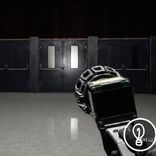
The plate in the fridge is empty long before Family Secrets 1: Empty Plate explains why that matters, and by the time the reason becomes clear, the game has already stopped feeling like an ordinary night of babysitting.
The story opens with Miko receiving a phone call from his mother, who tells him she’ll be away for work for several days. That single call is the entire setup: Miko is left responsible for his younger sibling, Jun, with no adult supervision and no clear sense of how long the arrangement will actually last.
Nothing about the premise announces itself as a horror game in the opening minutes. It plays out like an ordinary domestic evening — dinner, small conversations, the usual routine of looking after a younger sibling — and that ordinariness is doing more narrative work than it first appears to.
Miko isn’t written as a capable adult stand-in. He’s a kid handling a responsibility that’s clearly too large for him, and the game keeps that imbalance visible throughout rather than letting Miko grow conveniently competent as the story escalates.
Movement is handled entirely from a first-person perspective, using WASD to walk, E to interact with objects and dialogue, F to toggle the flashlight, and ESC to pause. There’s no combat system, no inventory to manage, and no upgrade path of any kind — every mechanic exists purely to support exploring the house and progressing the story.
The flashlight isn’t just there for atmosphere. Several details tucked into darker rooms are easy to miss entirely if a player doesn’t actively use it, and the game rewards players who check corners rather than walk straight through toward the next scripted event.
The title’s central image — a single plate left unwashed in an otherwise empty fridge — shows up early and without any dramatic framing, which is exactly why it lands the way it does once its significance becomes clear later on. Food, or the lack of it, threads through the rest of the game as a quiet marker of how badly the household is actually functioning.
Players are encouraged not to rush past the kitchen scene where this detail first appears, since the game doesn’t call attention to it directly and it’s easy to treat as background set dressing on a first pass.
This kind of restraint is consistent throughout Family Secrets 1: Empty Plate — the game rarely explains its symbolism outright, trusting players to notice a detail like the empty plate and carry that unease forward themselves.
Early in the game, tension builds slowly through ambient house sounds — footsteps, doors, Jun’s voice from another room — rather than through jump scares or scripted chase sequences. Players who go in expecting a monster-in-the-house structure tend to be the ones most caught off guard by where the story actually goes.
By the point a hide-and-seek scene appears, which has circulated widely in short clips online, the story has already shifted from ordinary domestic tension into something considerably heavier, tied directly to Miko and Jun’s relationship rather than an external threat entering the house.
A small number of players have reported a cutscene freeze or text-loading bug partway through, most often resolving on its own after a short pause rather than requiring a full restart, which is worth knowing before assuming a stalled scene means something has gone wrong.
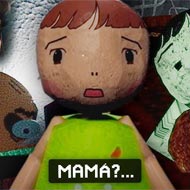
The claymation-inspired art style is frequently the first thing new players mention, since its soft, almost cozy look sits in deliberate contrast with where the story eventually goes. That contrast is one of the more divisive aspects of the game — some players find it unsettling in exactly the right way, while others feel the visuals undersell how heavy the narrative gets.
At roughly 30 to 40 minutes of total playtime for a $2 minimum price, the game’s short length is another point of debate. Some players see it as appropriately focused given the single-situation structure, while others wanted more room for Miko and Jun’s relationship to develop before the story ends.
Dialogue exchanges between the two siblings get singled out repeatedly in player comments as doing more character work than they initially seem to, which is part of why skipping through Jun’s lines too quickly tends to undercut the ending’s impact.
Family Secrets 1: Empty Plate doesn’t need a large house, a long runtime, or a cast beyond two siblings to make its point stick, and that empty plate sitting in the fridge is proof of how much the game gets out of a single unremarked detail rather than anything louder.





 Fullscreen