Easter Games
Zoonomaly Unblocked
Zoonomaly Cat

Choo‑Choo Charles

Palworld
Weekly Picks
Zoonomaly Unblocked
Zoonomaly Cat
Choo‑Choo Charles
Palworld

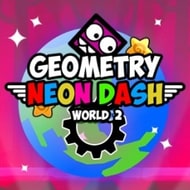
In Geometry: Neon Dash World 2 you start every level with exactly one input — a tap that makes your cube jump — and nothing else to fall back on. The cube moves forward on its own from the first second, and the only thing standing between a clean run and an instant restart is how precisely that tap lines up with the next hazard.
Every level runs on the same rule: the cube advances automatically, and tapping is the only way to clear spikes, saw blades, and narrow gaps. There’s no steering, so the skill ceiling rests entirely on timing a single input.
What separates a clean clear from a frustrating one is reading obstacles a beat ahead. A late tap throws off the rhythm for whatever comes right after, usually catching players still recovering from the first mistake.
Hitting any obstacle sends you straight back to the start, with no partial credit — the same all-or-nothing convention the entire one-tap platformer genre runs on.
This sequel leans into darker, cave-themed environments not part of the original Neon Dash World layout, swapping open corridors for shadowed passages where obstacle silhouettes are harder to pick out.
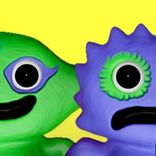
Monsters show up as a new obstacle layered on top of spikes and saw blades, with movement patterns that aren’t fixed the way a stationary spike row is. The safe jump timing shifts slightly from attempt to attempt.
Players from the first Neon Dash World have mixed reactions — some like that the sequel doesn’t just recolor the same patterns; others find the reduced visibility frustrating.
Stars are the main collectible, gathered by passing through them mid-run. Unlockable characters are what stars buy — alternate playable shapes that stay purely cosmetic. Level difficulty climbs steadily; deeper cave levels stack hazards close enough that one hesitant tap costs the run.
That curve is where most debate comes from. Casual players who enjoyed the forgiving early levels bounce off once monsters and tight gaps overlap, while players chasing a no-hit run treat that overlap as the actual game.
By the time you’ve unlocked a second or third character, the game has usually stopped being about reflexes alone and started rewarding memorized timing instead.
Geometry: Neon Dash World 2 doesn’t reinvent the one-tap formula it’s built on, but the cave sections and monster enemies give it enough identity to avoid feeling like a straight reskin. Once you’ve adjusted to reading shadowed silhouettes instead of bright corridors, the stars scattered through each level feel like proof you cleared it cleanly.



 Fullscreen