Easter Games

Zoonomaly Unblocked

Zoonomaly Cat

Choo‑Choo Charles

Palworld
Weekly Picks
Zoonomaly Unblocked
Zoonomaly Cat
Choo‑Choo Charles
Palworld





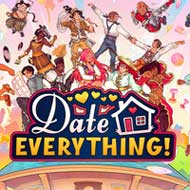
One of the romance options in Date Everything! isn’t humanoid at all. It’s a sphere, floating, featureless, and somehow still written with enough personality that players end up genuinely attached to it by the end of the route. That single detail tells you almost everything about the tone here: a dating sim set at an academy built between dimensions, where the cast ranges from ordinary-looking classmates to students who don’t resemble anything from your side of reality, and the game treats all of them with the same sincerity.
| Genre | Dating Simulation / Visual Novel |
| Platform | Browser |
| Setting | Interdimensional Academy |
| Controls | Mouse and Keyboard |
The premise is simple to state and stranger to actually play through: you’ve been accepted into Interstice Academy, a school that sits in the gap between dimensions, and your classmates reflect that setting. Some look human enough to pass without comment. Others clearly don’t, and Date Everything! never treats that as a punchline on its own, which is part of why the sphere route landed the way it did with players who went in expecting a more conventional cast.
The world-building leans into a modern-fantasy tone, mixing mythical creatures and dimension-hopping students into a setting that feels more like a school comedy than a fantasy epic, right up until a conversation with someone shifts into something more sincere. That tonal range is deliberate, and it’s the reason the game reads as funnier and more emotionally direct than most dating sims in the same space.
Because the roster spans that many kinds of students, the early hours are mostly about figuring out who you even want to pursue before the game leans on you to commit to a route. Players who like sampling every option before settling tend to spend longer in this stage than players who latch onto one suitor immediately and chase that thread.
Instead of a simple menu of dialogue choices, most of the ongoing relationship management happens through an in-game phone. You text characters between story beats, and how you respond shapes tone and trust in ways that carry into the next scene. The writing behind this system is genuinely deep, reportedly built from several hundred separate handwritten exchanges spread across the cast, which is part of why so few conversations feel copy-pasted between routes.
The phone also gates two other systems that matter more than they first appear:
None of this is explained with much hand-holding, so new players sometimes ignore the phone for stretches at a time and miss messages that quietly affect how warm a character is toward them later.
The sphere is the detail everyone brings up first, and for good reason. It has no face in the conventional sense, no humanoid body, and the game still manages to write flirtation, jokes, and a believable emotional arc around it. Players who came in for a straightforward otome-style romance often mention the sphere route as the moment they realized Date Everything! wasn’t playing it safe.
That willingness to commit to strange premises extends to how routes are structured generally. A typical session tends to follow a fairly consistent shape once you’ve picked someone to focus on:
It’s a loop that rewards players who treat texting as seriously as the main scenes, since skipping ahead tends to flatten a route’s emotional pacing.
The most common mistake is treating every choice as binary, good or bad, when a lot of the writing rewards consistency of tone over any single correct answer. Picking a joke response once isn’t going to sink a route, but consistently ignoring a character’s texts while playing sincere in the main story creates a mismatch the game does track.
The second mistake is rushing through early conversations to get to a story beat, since some of the best character writing lives in the smaller phone exchanges rather than the marquee scenes. Players who skim past those texts tend to find later emotional beats land with less weight, simply because the groundwork wasn’t there.
By the time a route reaches its more serious stretch, usually once the Glossary has filled in enough lore to explain a character’s home dimension, the tone shift from comedic texting to something sincere can feel abrupt if you weren’t paying attention to how it built up.
The Glossary ends up being more load-bearing than it looks at first glance. It’s easy to treat as flavor text, but entries here explain why certain characters behave the way they do, and it’s often the only place the game directly states facts that dialogue only gestures at.
Wallpaper unlocks function as a quiet scoreboard. Because they’re tied to specific relationship milestones, players comparing notes often use which wallpapers they’ve unlocked as shorthand for how far they’ve gotten on a given route, without needing to spoil actual story content.
One detail only playing reveals: the small chime that plays when a wallpaper unlocks lands at a slightly different moment on every route, and attentive players start using that sound as an early warning that a scene is about to shift tone.
The most consistent debate is about the non-humanoid routes. Some players think characters like the sphere are the best writing in the whole game precisely because they had no reason to work and do anyway. Others find the tonal whiplash between broadly comedic texting and genuinely sincere emotional scenes hard to reconcile, especially on routes that pivot quickly.
There’s also a smaller, ongoing disagreement about pacing. Because so much of the relationship-building happens through phone messages rather than full scenes, some players feel routes take longer to feel like they’re going anywhere compared to more traditional visual novels, while others consider that slower burn the whole appeal.
Yes. The most talked-about example is a floating, sphere-shaped student with no humanoid features at all, and the route built around it is written with the same emotional weight as any of the more conventional-looking classmates.
They do, though not always in an obvious binary way. Tone and consistency across both the phone conversations and the main story scenes shape how warm a character is toward you, and inconsistent responses can flatten a route rather than immediately failing it.
Beyond conversation, the phone gates wallpaper unlocks tied to relationship milestones and gradually opens up the Glossary, which fills in world lore about the Academy and its students as you spend more time with them.
Date Everything! earns its strangeness by committing to it fully, whether that means writing a sincere romance for a character shaped like a sphere or letting the Glossary quietly explain why Interstice Academy works the way it does. It’s a dating sim willing to bet that players will follow a good route wherever it leads, humanoid or not.




 Fullscreen