Easter Games
Zoonomaly Unblocked
Zoonomaly Cat
Choo‑Choo Charles

Palworld
Weekly Picks
Zoonomaly Unblocked
Zoonomaly Cat
Choo‑Choo Charles
Palworld

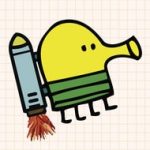
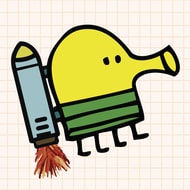
In Doodle Jump you start on a single platform near the bottom of the screen with nothing below you but open space, which matters the moment you realize there’s no way back down. The Doodler is already climbing before you’ve processed the controls, bouncing from platform to platform as the screen scrolls upward and anything left behind falls out of view. You’re not playing to survive a level in this game — you’re playing to see how long you can climb before a gap catches you out.
| Genre | Endless Vertical Platformer |
| Platform | Browser, desktop and mobile |
| Core Mechanic | Automatic bouncing between ascending platforms |
| Hazards | Black holes, UFOs, moving and crumbling platforms |
| Boosters | Springs, propeller hats, jetpacks, rockets |
Movement is left and right only. The Doodler bounces automatically on contact with a platform, so your job is steering where it lands next while the camera keeps climbing regardless.
Falling behind the bottom edge ends the run instantly. That pushes the difficulty into positioning rather than reflexes — reading two or three platforms ahead, not just the one under the Doodler.
The lowest platforms are almost always solid ground. That lulls new players into a false sense of security before the platform variety mixes in.
Springs give a short boost on landing, launching the Doodler higher than a normal bounce. Propeller hats and jetpacks lift you straight up for several seconds regardless of platforms below.
Beginners grab boosters the instant they appear instead of saving one for a sparse stretch ahead. Rockets push harder and longer, and grabbing one mid-cluster often wastes a boost you didn’t need.
The habit runs backwards constantly. Players chase every booster instead of saving reactions for a platform about to disappear.
Early on, platforms are mostly stationary and evenly spaced, giving time to plan each landing. By a few hundred points in, moving platforms slide sideways, and breakable ones crumble the instant the Doodler touches them.
Black holes start around the same stretch. Getting pulled into one sends the Doodler spinning off randomly, which can save a bad jump or ruin a good one just as easily.
UFOs show up a little later and abduct the Doodler on contact, stalling the climb for a moment before dropping you back a few platforms lower.
There’s a specific stomach-drop moment when the Doodler gets pulled sideways into a black hole mid-jump. Regulars know instantly from the spin that the landing is lost.
The UFO grab has its own rhythm too — a brief pause in the climb, then the Doodler gets carried off before dropping back a beat later.
Casual players treat every platform the same way. More careful ones sort platforms by type before they reach them, and that habit is the real skill under the bouncing.
Community talk leans on shorthand. A run that ends from missing a platform entirely gets called a whiff, and a clean stretch of stationary platforms gets called a breather section.
Players also talk about booster-chaining. It means stacking a spring into a jetpack into a rocket for one long climb without touching a platform.
Not every part of the formula gets loved equally. Some find the black hole’s random spin frustrating since it can undo a good jump through no fault of the player, a fair gripe that comes up often.
Doodle Jump never changes its central promise — climb as far as the Doodler can carry you before one platform, one black hole, or one mistimed booster ends the run. What keeps players coming back is how differently each climb plays out once moving platforms, UFOs, and crumbling ledges start layering together.



 Fullscreen